1
Binary · no host OS
0
Host packages to patch
3
Server models · R640 / R650 / R660
How the options actually differ
Most organizations evaluating a path off the incumbent are comparing license economics, attack surface, and whether existing iron stays useful. Here is the practical comparison.
| Dimension | Incumbent path | Typical alternatives | RayNu-V |
|---|---|---|---|
| License model | Subscription / renewed economics under Broadcom | Varies; often still subscription or support-tied | Designed to keep existing iron productive without the same treadmill |
| Host OS / attack surface | Mature, large surface | Often includes a host OS or larger control plane | Single EFI binary · no host OS |
| Isolation assurance | Testing + process + track record | Testing + process | Designed for formal verification; living paper tracks proved vs open |
| Hardware re-use | Pressure toward refresh to stay current | Often assumes newer platforms | Optimized for PowerEdge R640 / R650 / R660 you already own |
| Audit evidence | Vendor reports + operational logs | Varies widely | Immutable audit trail + living verification paper |
Where the work stands
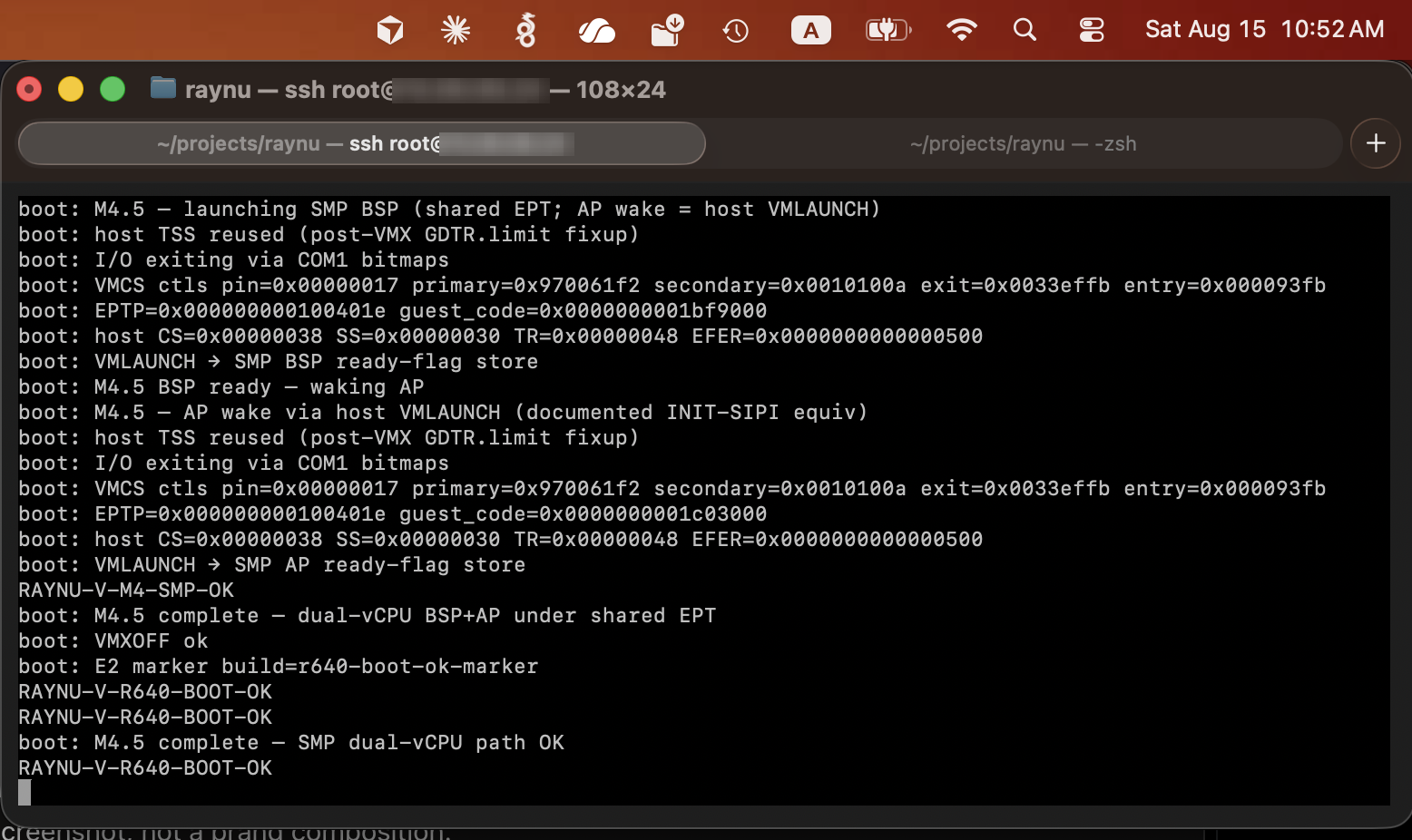
Early does not mean opaque. Lab gates through M6 are closed on Latitude +
QEMU. Real PowerEdge R640 closed Mount Everest on 11 September 2026:
network SPA installed Alpine to virtio disk and rebooted into it
(RAYNU-V-M7-ISO-INSTALL-OK /
RAYNU-V-RAYNU-F-DISK-BOOT-OK). Next work is explicit:
M8 operator hardening (TLS, leftover persist, console UI) — not a
reopened Everest.
RAYNU-V-R640-BOOT-OK
Closed
RAYNU-V-M7-UEFI-HTTP-OK
Closed
RAYNU-V-M7-HOST-NIC-HTTP-OK
Closed
RAYNU-V-M7-E4-SPA-LAUNCH-OK
Closed
RAYNU-V-M7-ISO-INSTALL-OK
Closed
Full tracker and living verification paper are public. Claims never run ahead of evidence.
What changes for the business
Capital & budget
Defer the forced refresh
Keep existing PowerEdge fleets productive instead of writing them off early to chase a vendor’s support calendar or licensing terms.
Security posture
Isolation designed to be proved
Isolation is treated as a property that should ultimately be machine-checked. That design choice is the long-term advantage.
Operational model
One binary, clear surface
Deploy and operate on iron you already manage through iDRAC. No mystery appliance stack. No host OS to harden and patch.
Audit & compliance
Evidence, not slides
A living verification paper and immutable audit trail turn hypervisor events into something a security team or auditor can examine.
The isolation property we are building toward
Most hypervisors ask you to trust testing, process, and historical track record. That is necessary — and incomplete. RayNu-V treats the isolation boundary as something that should ultimately be machine-checked.
For every valid guest-to-host memory mapping, that physical frame is owned by exactly one guest — and belongs to neither the hypervisor nor any other guest.
That property is pursued with Verus and Kani on a deliberately small Proven Core. Full formal verification will take time; we do not claim it is finished. What is true today: the architecture is designed from the first line for this standard, maturity is published in a living paper that tracks proved versus open work, and this is already closer to a machine-checked isolation story than commercial hypervisors currently running on the same PowerEdge R640-class iron.
What a design partnership looks like
Early should mean opportunity, not opacity. A design partnership is a concrete, reversible evaluation on hardware you already own.
- Lab first. We deploy RayNu-V on one of your R640s (or equivalent) alongside your existing stack — no production cutover.
- You inspect everything. Living verification paper, audit trail, architecture, and iron evidence are open for your security and platform teams.
- Side-by-side, not big-bang. Evaluate guest behavior, management surface, and operational fit without replacing the incumbent.
- Exit is always available. If it does not meet your bar, you remain on your current path. There is no lock-in from a lab evaluation.
Design partners also get direct access to the engineering team and influence on the near-term roadmap. That is the advantage of being early.
Questions CIOs usually ask next
What happens to my VMs on day one?
Nothing disruptive in a design partnership. Evaluation runs in the lab beside your existing environment. There is no forced migration and no requirement to move production workloads until you decide the path is sound.
Can we go back if RayNu-V does not fit?
Yes. A lab evaluation leaves your incumbent stack untouched. Rollback is simply continuing to run what you already run. We design the trial so the downside is time and attention, not irreversible change.
Is formal verification finished?
No. Full machine-checked isolation of the core property will take time. We publish a living verification paper that tracks what is proved versus what remains open. The honest claim today is design-from-day-one plus measurable progress — not a finished proof.
Why R640 / R650 / R660 specifically?
That is the iron many organizations still have in volume and still find productive. RayNu-V is optimized for those platforms first so you can extend useful life instead of accepting a forced refresh cycle.
See it on your hardware
If you own or influence a Dell PowerEdge estate and want a serious, inspectable path to extending its productive life, reach out. Design-partner conversations are open.
Technical journey and iron evidence live on the main site. Architecture and ADRs are on GitHub. Progress tracker: distance to production readiness.